If you've had a garage floor franchise in your living room lately, you've heard the pitch: "Epoxy is old technology. Polyurea is stronger, it's flexible, and we install it in one day." It's a slick pitch, and pieces of it are even true. But it leans on a comparison that doesn't quite exist — and the one-day part, which sounds like a benefit, is actually the biggest tradeoff in the deal. Here's the whole picture.
What these materials actually are
Epoxy is a two-part thermoset resin that cures slowly and builds thick, hard layers. Its superpower is penetration: applied over properly ground concrete, it has time to soak into the open pores of the slab before it sets, creating a mechanical grip inside the concrete rather than a film on top of it.
Polyurea is a different resin family whose defining trait is speed — some formulations gel in minutes. It's also more flexible than epoxy and naturally UV-stable, which is why it took over the topcoat market. Its weakness is the flip side of its strength: a resin that sets in minutes has only minutes to bond with the slab underneath it.
The part the pitch skips: polyaspartic — the premium topcoat used across the industry, including by us — is a polyurea. It's a refined version engineered for controlled cure and UV stability. So when a franchise says "polyurea vs. epoxy," they're framing a layer decision as a brand war. The real question is: which chemistry belongs in which layer?
The cure-speed tradeoff, explained with a sponge
Diamond-ground concrete behaves like a stiff sponge — full of open pores that a liquid resin can flow into before it hardens. Whatever fills those pores becomes the anchor for the entire floor system.
Give a slow-curing epoxy base coat those pores and it wicks in deep, then hardens into thousands of microscopic roots. Give the same pores a fast-set polyurea and it starts gelling before it's finished soaking. The floor still looks identical on day one. The difference shows up in year three, under the rear tires of a truck that just drove home on a 105° Texas afternoon — hot-tire pickup peels shallow bonds, not deep ones.
That's the honest reason one-day installs are possible: the chemistry is chosen to fit the schedule, not the other way around. Fast cure isn't a performance feature. It's a logistics feature — it lets a crew do five houses a week instead of three. That's great for the franchise. It's neutral-to-bad for your slab.
Head to head
| Epoxy (as a base coat) | Fast-set polyurea (as a base coat) | |
|---|---|---|
| Bond to concrete | Deep penetration into ground slab | Shallower — cures before full soak-in |
| Build thickness | Thick, rigid, high-build foundation | Thinner per coat |
| UV resistance | Poor — must be topcoated (it always is) | Good |
| Flexibility | Rigid | Flexible |
| Install speed | Needs overnight cure — 2-day job | Enables the 1-day job |
| Who benefits from the speed | — | Mostly the installer's schedule |
To be fair: when polyurea-first makes sense
We'd rather be straight with you than win every argument. A polyurea-heavy system is a reasonable choice when the schedule genuinely can't flex — a commercial space that can only close for one day, or an install in freezing weather where slow-curing products struggle (not a big problem in North Texas). And polyurea's flexibility has real value over slabs with active movement. What we push back on is the claim that faster cure means a stronger floor. On a properly prepped residential garage, it's the opposite: cure time is bond time.
How we build it: both chemistries, each in its lane
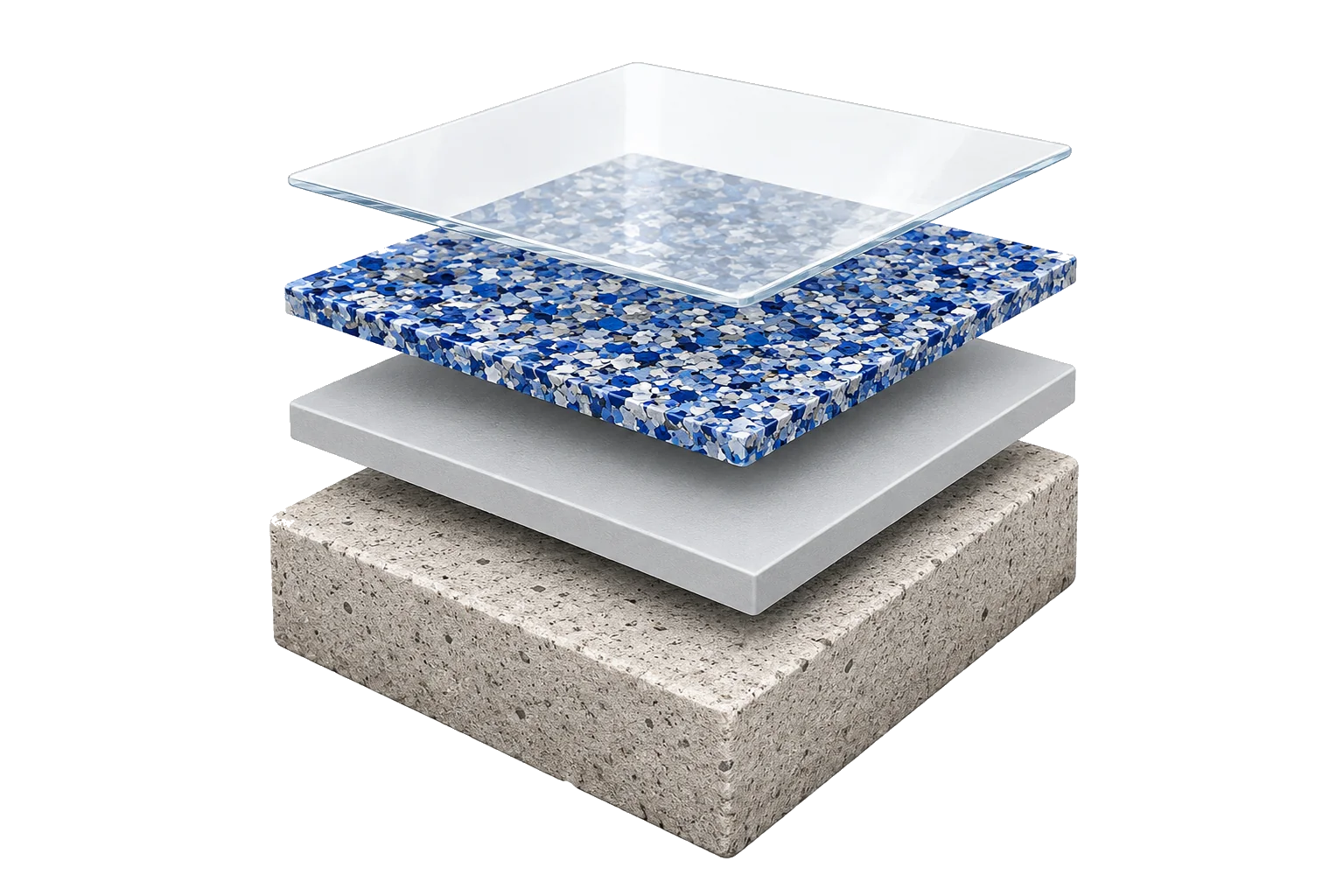
Our standard system is four layers, and it uses the strongest material for each job:
- Diamond-ground concrete — the prep that opens the slab's pores (we never acid-etch)
- Epoxy base coat — slow cure, deep soak, maximum anchor
- Flake or quartz broadcast — the decorative wear layer, in your choice of 26+ colors
- Polyaspartic topcoat — the polyurea-family finish, exactly where its UV stability and abrasion resistance belong: on top
Day one is grind, repair, base, and broadcast. Day two is the topcoat. The floor gets epoxy's bond and polyurea's finish — which is why "polyurea vs. epoxy" was never the real question.
Our verdict
Judge bidders by their prep and their layers, not their buzzword. If a quote says "polyurea" but the crew will be gone by dinner, the coating didn't have time to become part of your slab. If a quote says "epoxy" with no UV-stable topcoat, the floor will yellow. The right answer uses both — epoxy down where bond matters, polyaspartic up where sunlight hits — with a full day of cure in between.
Wondering what all of this costs? Our complete cost guide publishes the real numbers. Comparing more than these two options? See all seven garage floor options ranked. And if you're getting one-day pitches out in Granbury or Weatherford — that's our service area, and the two-day option is a phone call away.